
Rigetti Computing
From a $0.38 penny stock to a quantum computing powerhouse — the full story of RGTI’s past, present, and explosive future potential.
From MIT Labs to Nasdaq: The Rigetti Story
In 2013, Chad Rigetti — a former researcher at IBM’s quantum computing group — had a vision that seemed almost absurd at the time: build a full-stack quantum computer from the ground up. Not just software. Not just algorithms. The actual quantum chips, the fabrication facility, the cloud infrastructure, the whole stack. That ambition founded Rigetti Computing in Berkeley, California.
A decade later, that vision has been validated by the world’s largest governments, the biggest names in tech, and a wave of institutional investors. What began as a stealth-mode startup backed by Y Combinator is now a publicly traded company with a 108-qubit quantum computer running live on Amazon, Microsoft Azure, and its own cloud platform.
Former IBM quantum researcher founds Rigetti Computing in Berkeley, CA. Backed by Y Combinator. Mission: build the world’s most powerful quantum computers.
Released Forest 1.0, a quantum programming environment, opening access to quantum computing for developers. Series B/C rounds raise over $119M to expand Berkeley HQ and advance 32-qubit systems.
Rigetti launches QCS, shifting from hardware vendor to cloud-first provider. NASA and Oak Ridge National Laboratory gain remote access to quantum processors. A transformational business model shift.
Rigetti announces the world’s first multi-chip quantum processor — a proprietary modular architecture designed for scalability. Simultaneously announces SPAC merger plans at a $1.5B valuation. Strategic investors include T. Rowe Price, Palantir, and In-Q-Tel.
SPAC merger with Supernova Partners closes. RGTI lists on Nasdaq, raising $261.75M in gross proceeds. Opens at $9.75. New CEO Dr. Subodh Kulkarni takes over in December, bringing 30+ years of semiconductor experience.
Post-SPAC correction and quantum sector skepticism sends RGTI to $0.38 in May 2023 — a 96% decline from IPO. But the company keeps building: 84-qubit Ankaa processor unveiled, partnerships expanded, fabrication tech improved.
Rigetti achieves the 84-qubit Ankaa-2 system with 98%+ gate fidelity. Multi-year AFRL contract secured. Stock begins recovering as institutional investors recognize the fidelity milestone’s significance.
36-qubit multi-chip system hits 99.5% fidelity — the “quantum advantage threshold.” Stock surges 5,000%+ over 12 months, hitting $58.15 in October 2025. Market cap briefly reaches $17B. NVIDIA NVQLink partnership announced. $5.7M Novera QPU orders secured.
Cepheus-1-108Q goes globally available on Amazon, Azure, and qBraid. Revenue surges +199% YoY to $4.4M in Q1. US CHIPS Act commits $100M. UK investment of $100M announced. $8.4M C-DAC order from India secured. Stock trading ~$21.77.
The Wild Ride: $9.75 → $0.38 → $58 → Today
No quantum stock has had a more dramatic journey than RGTI. Understanding that journey is essential for any investor considering a position today — because the story of where it’s been reveals exactly why the current price could be a compelling entry point.
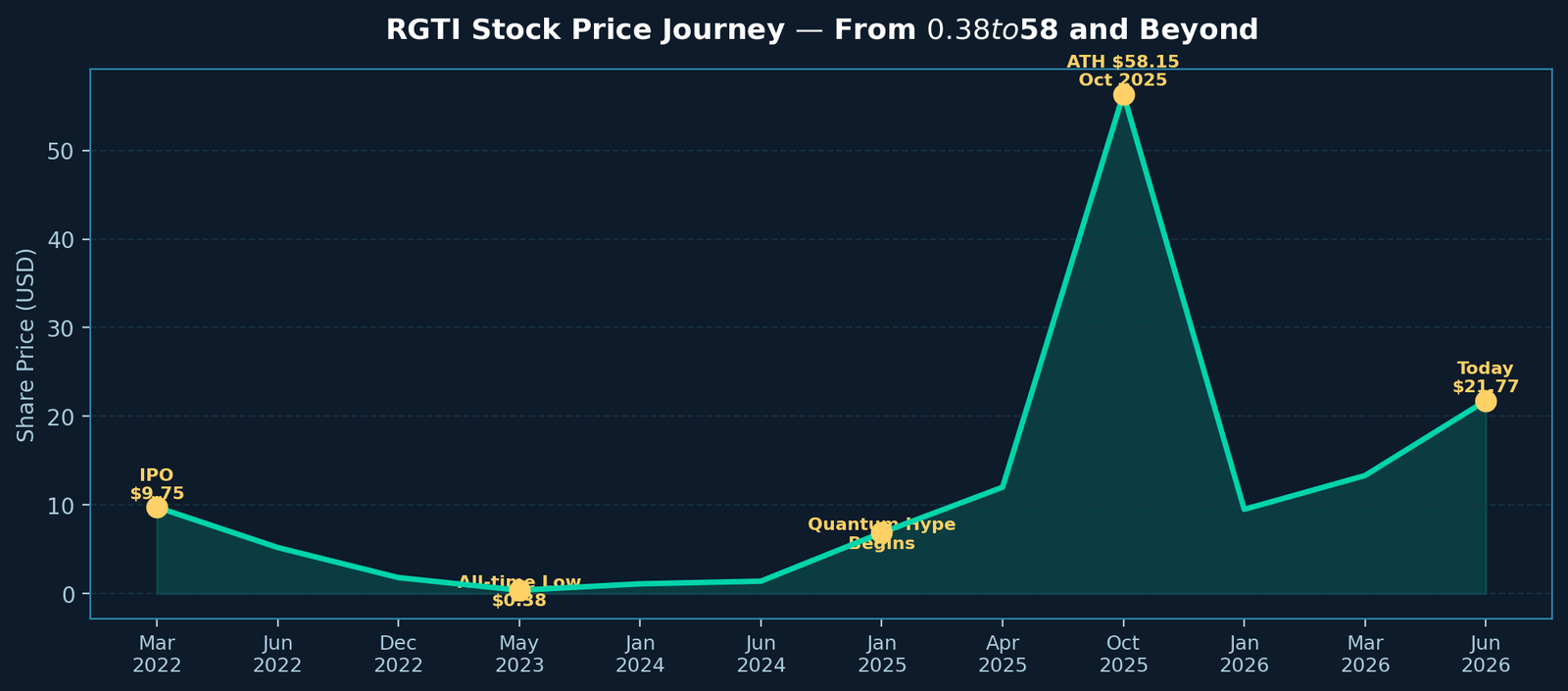
RGTI Stock Price Journey — Key Levels & Inflection Points (2022–2026)
Phase 1: The SPAC Hangover (2022–2023)
RGTI opened at $9.75 on its first trading day in March 2022. Like nearly every SPAC-merged company in that era, it suffered a brutal correction. Rising interest rates, tech sector selloffs, and a general collapse in speculative growth names sent RGTI all the way to $0.38 in May 2023 — a 96% decline from its first-day price. For most investors, this would be a death sentence. For Rigetti, it was a buying opportunity hiding in plain sight.
Phase 2: The Silent Build (2023–2024)
While the stock languished under $2, the engineering team was quietly executing. Rigetti launched new Ankaa-class processors, improved gate fidelity past 98%, and secured multi-year government contracts with the Air Force Research Laboratory. Institutional investors paying attention began accumulating. Volume picked up. The stock quietly doubled from its lows.
Phase 3: The 5,000% Quantum Surge (2024–Oct 2025)
The catalyst was a fidelity breakthrough. When Rigetti’s 36-qubit multi-chip system hit 99.5% median two-qubit gate fidelity — what analysts called the “quantum advantage threshold” — institutional money poured in. Combined with Google’s Willow chip announcement reigniting quantum excitement globally, RGTI rocketed from under $2 to an all-time high of $58.15 in October 2025. The 12-month return exceeded 5,000%. The market cap briefly touched $17 billion.
Phase 4: The Healthy Reset (Late 2025–Today)
Profit-taking, a tough Q3 2025 revenue report, and sector rotation brought RGTI back down to the $8–$15 range. Then the CHIPS Act funding, the UK announcement, and the 108-qubit launch sparked a new rally. The stock trades around $21.77 today — still 62% below its all-time high, yet up 93% over the past year and over 5,944% from its 2023 low.
Revenue Reality: The Inflection Has Arrived
Critics have long pointed to Rigetti’s small revenue figures as a red flag. Those critics missed the context: quantum computing is still in its commercial infancy, and Rigetti was investing every dollar into R&D and hardware development. Now, that investment is starting to pay off — and Q1 2026 made the revenue inflection impossible to ignore.
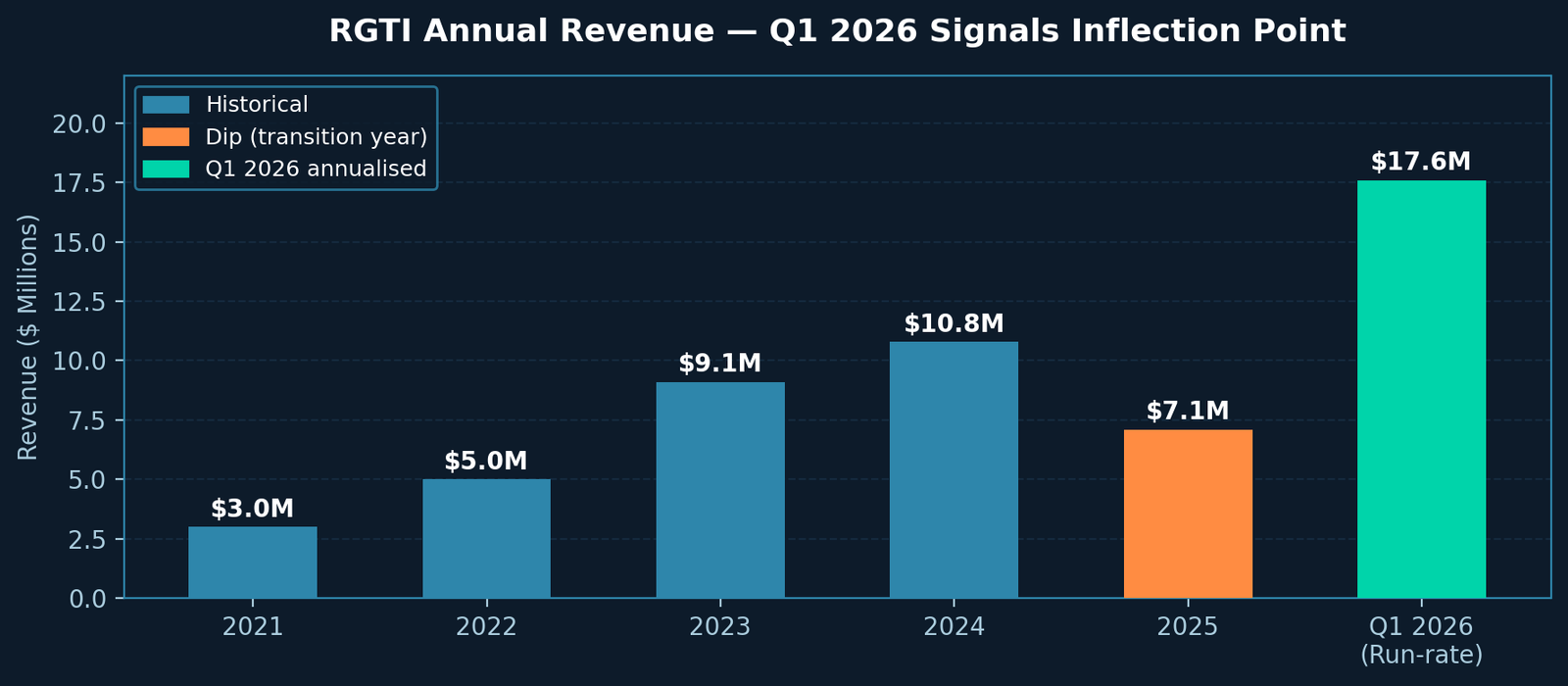
RGTI Revenue Trend — Q1 2026 Annualised Run-Rate Signals $17M+ Year Ahead
- Q1 2026: $4.4 million revenue — up 199% year-over-year. The biggest single-quarter revenue jump in Rigetti’s public history.
- $569 million in cash and investments as of March 31, 2026. Zero near-term capital raise needed.
- $8.4M order from India’s C-DAC — single largest government order to date, opening a massive new market.
- $5.7M in Novera QPU purchase orders (2025) — on-premises hardware sales proving commercial demand exists now.
- Gross proceeds from the 2022 SPAC: $261.75M. Additional capital raises in 2024–2025 brought total liquidity to $569M.
The 2025 revenue dip (to $7.1M from $10.8M in 2024) was a transitional year: older systems were phased out as the 36Q and 108Q platforms were developed. That transition is now complete. With the 108Q globally available and government contracts flowing, the revenue ramp is underway.
Why the Technology Moat Is Real
Quantum computing has many claimants. What separates Rigetti from most is vertical integration and the chiplet architecture — two advantages that are extremely difficult to replicate and that compound over time.
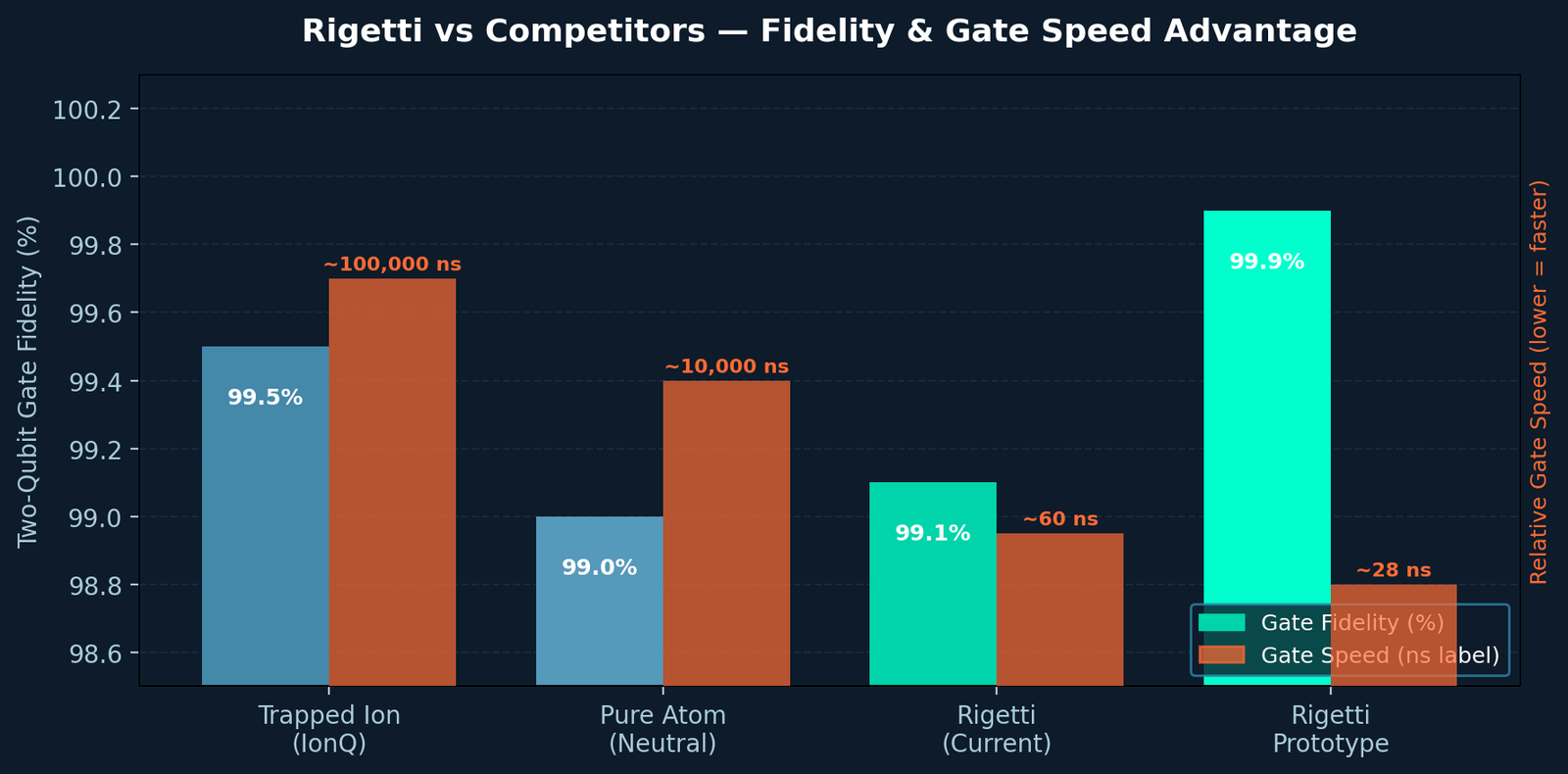
Rigetti vs Key Modalities — Gate Fidelity & Speed Comparison (2026)
The Chiplet Advantage — Explained Simply
Think of building a quantum processor like building a city. Monolithic chips (what competitors use) are like trying to build a city on a single block — you hit physical limits fast, and every defect in the block ruins the whole city. Rigetti’s chiplet architecture connects smaller, near-perfect “neighborhoods” together. Each chiplet can be quality-controlled individually, then tiled into a larger system without propagating defects. This is why Rigetti can scale from 36 to 108 to 1,000+ qubits while maintaining high fidelity — and why nobody else has managed to do this at scale.
Own Fab = Unmatched Control
Rigetti is the only publicly traded quantum company that owns its own chip fabrication facility — Fab-1 in Fremont, California. This means Rigetti controls its own destiny: faster iteration cycles, proprietary process improvements, and no dependence on third-party foundries that serve competitors too. It’s the quantum equivalent of Apple owning its chip design team vs. buying off-the-shelf chips.
- 99.9% two-qubit gate fidelity on prototype — matching ion trap on fidelity while being 1,000× faster
- 108-qubit Cepheus-1-108Q — industry’s largest modular quantum system, GA on all major clouds
- Proprietary adiabatic CZ gate scheme — enables unprecedented fidelity at speed
- Fab-1 in Fremont, CA — fully owned fabrication; no third-party dependency
- Roadmap to 150+ qubits (2026) and 1,000+ qubits (2027) with documented milestone-delivery track record
The $450 Billion Market Nobody Has Won Yet
The quantum computing market is not just growing — it is about to explode. From drug discovery to financial modeling to national defense cryptography, quantum computers will solve problems that classical supercomputers simply cannot. And the market is still in its first innings.
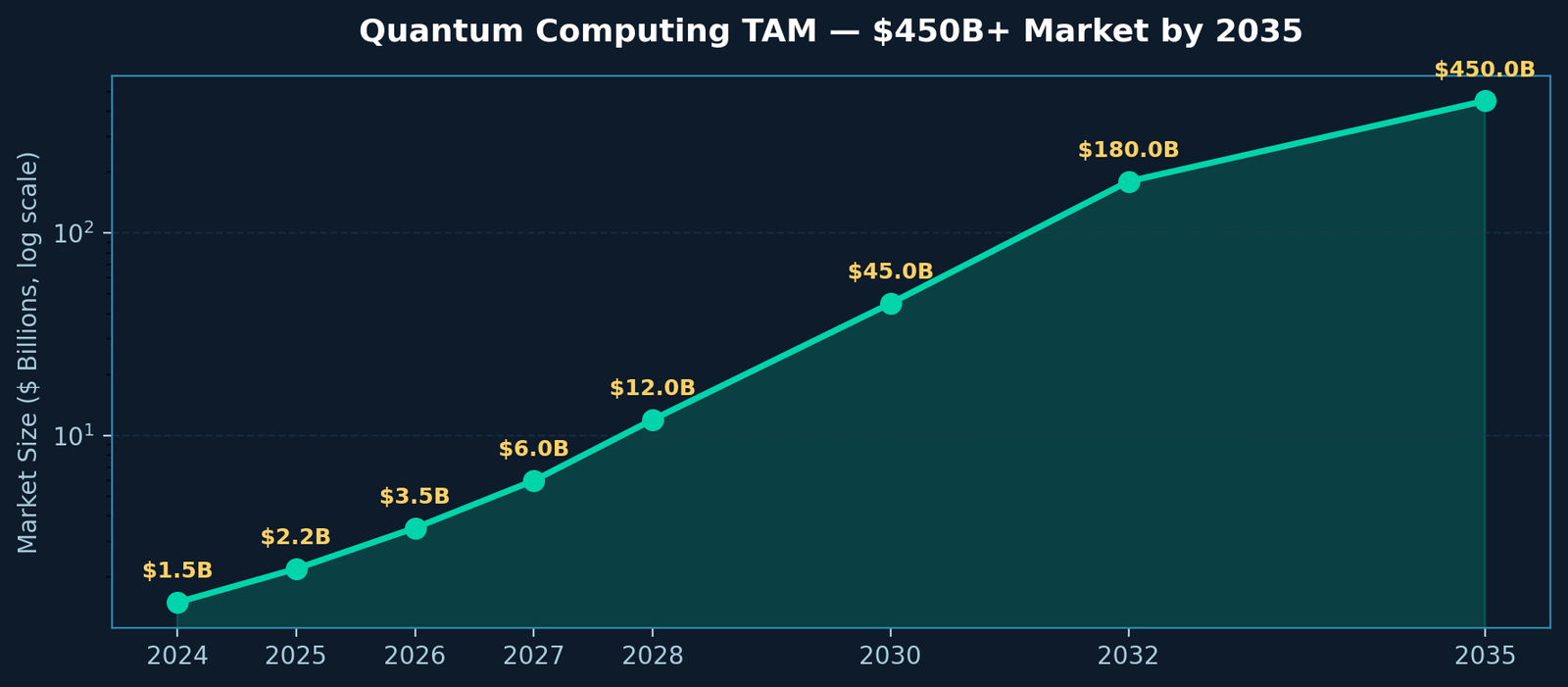
Quantum Computing Total Addressable Market — $450B+ by 2035 (Log Scale)
Catalysts That Will Drive RGTI’s Next Chapter
150+ Qubit Launch (Late 2026)
Next system targets 99.7% fidelity. Each qubit tier unlocks new enterprise and government customers willing to pay premium prices.
$100M US CHIPS Act Grant
Signed letter of intent with the US Dept. of Commerce. Multi-year funding stream with US government as a partner — the strongest validation possible.
$100M UK Investment
First major international expansion. Deploying 1,000+ qubit system in the UK within 3–4 years. Opens EU, Commonwealth, and government contract pipelines.
1,000-Qubit System (2027)
The holy grail. A 1,000-qubit fault-tolerant system could re-rate Rigetti from a hardware startup to a genuine quantum utility. This is the stock’s 10× scenario.
NVIDIA NVQLink Integration
Rigetti is embedded in NVIDIA’s open quantum-AI integration platform. As AI supercomputers scale to trillion-parameter models, Rigetti becomes their quantum co-processor of choice.
India & Global Expansion
$8.4M C-DAC order from India signals a global pipeline. The world’s fastest-growing tech economy just became a Rigetti customer. More to follow.
13 Analysts. One Verdict: BUY.
Thirteen Wall Street analysts cover RGTI with a unanimous Buy consensus and a 12-month price target of $29.24, representing roughly 34% upside from current levels. Some community fair value models place RGTI’s intrinsic value as high as $51 — suggesting the stock could be trading at a 68% discount to its true worth today. BlackRock and Vanguard are already major institutional holders.
The Bull Case vs. The Risks
Every high-conviction investment thesis deserves an honest look at both sides. Here is the unvarnished version:
✦ Why RGTI Could Be a 10× Stock
- $569M cash — fully funded through 2027 roadmap
- $200M in US + UK government grants secured
- Only pure-play with own chip fab (Fab-1)
- Revenue growing 199% YoY — inflection proven
- NVIDIA NVQLink integration opens AI TAM
- 1,000-qubit target by 2027 = re-rating event
- 13/13 analysts rated Buy with 34%+ upside
- Global expansion into UK, India, EU pipeline
- 62% below all-time high — still room to run
⚠ Risks to Understand First
- Still pre-profit: operating losses continue
- Revenue small relative to market cap ($5B+)
- High volatility: dropped 96% once before
- DARPA Phase B setback in 2025 hurt credibility
- Competition from IBM, Google, IonQ intensifying
- Government equity stakes may dilute shareholders
- Commercialization timeline remains uncertain
- Insider sales observed after recent rally
The balance of risks and rewards here is clear for investors with a multi-year time horizon. RGTI is not a stock for someone who needs to be right in 90 days. It is a stock for someone who believes quantum computing will be one of the defining technology platforms of the next decade — and wants exposure to the company with the best hardware, the most cash, and the clearest roadmap to get there.
Why You Should Consider Owning RGTI Today
Let’s distill the entire thesis into the five most powerful reasons to own Rigetti Computing stock right now:
- You’re buying at 62% below the all-time high. The stock hit $58.15 in October 2025. It’s at $21.77 today. The fundamental story is stronger than it was at $58 — with more qubits, more cash, more government backing, and higher revenue. The discount is a gift.
- The government is your co-investor. The US and UK governments have committed $200 million to Rigetti specifically. When nations with trillions in resources decide a single quantum company is worth backing, retail investors should take note. The US government is also taking an equity stake — they need Rigetti to succeed.
- The technology is proven, not promised. Rigetti doesn’t just talk about qubits — it ships them. The 108-qubit Cepheus-1-108Q is available RIGHT NOW on Amazon and Microsoft Azure. You can pay to use it today. This isn’t vaporware; it’s a product generating real revenue.
- The revenue inflection has started. Q1 2026’s +199% YoY growth is not an accident — it’s the result of years of hardware investment finally reaching paying customers. This is what the early part of an S-curve looks like. The hard part (building the tech) is done. The easy part (selling access to it) is just beginning.
- The 1,000-qubit moment could re-price everything. If Rigetti delivers its 1,000-qubit system by 2027 as planned, it crosses into fault-tolerant quantum computing territory. At that point, Rigetti stops being a speculative hardware company and becomes a critical national infrastructure provider. The valuation re-rating at that moment could dwarf even the 2025 run.
Full Investment Snapshot
| Metric | Details |
|---|---|
| Ticker & Exchange | RGTI — Nasdaq Capital Market |
| Founded | 2013 by Chad Rigetti (former IBM quantum researcher) |
| Public Since | March 2, 2022 (SPAC merger, $261.75M raised) |
| All-Time Low | $0.38 — May 4, 2023 (−96% from IPO) |
| All-Time High | $58.15 — October 14, 2025 (+15,200% from ATL) |
| Current Price | ~$21.77 (as of June 8, 2026) |
| 52-Week Range | $10.30 — $58.15 |
| 1-Year Return | +93.6% |
| From All-Time Low | +5,944% |
| Current System | 108-qubit Cepheus-1-108Q (GA on AWS, Azure, QCS) |
| Best Gate Fidelity | 99.9% two-qubit (prototype) at 28ns gate speed |
| Cash Position (Q1 2026) | $569 million |
| Q1 2026 Revenue | $4.4M (+199% YoY) |
| Government Commitments | $200M — US CHIPS Act + UK National Quantum |
| Key Partners | NVIDIA, Amazon, Microsoft, C-DAC, AFRL, UK Gov |
| 2026 Roadmap | 150+ qubit, 99.7% fidelity |
| 2027 Roadmap | 1,000+ qubit fault-tolerant system |
| Analyst Rating | BUY — 13/13 analysts |
| 12-Mo Price Target | $29.24 (~34% upside) |
| Key Institutional Holders | BlackRock, Vanguard |
The Quantum Revolution Isn’t Coming. It’s Here.
Rigetti has survived the valley of death, built the technology, secured the government, and is now scaling revenue. The question isn’t whether quantum computing wins — it’s whether you’re positioned when it does.




Leave A Comment