
Why Investors Are Suddenly Paying Attention to Quantum Stocks
For most of the last decade, quantum computing lived in a strange place — too futuristic for serious business pages, too real to dismiss as science fiction. That gap is closing fast. In the last twelve months, the publicly traded quantum companies have posted breakthroughs that even skeptical Wall Street analysts are starting to call “the inflection point.” If you’ve been waiting for a moment to look seriously at this sector, this is starting to look like one.
What Quantum Computing Actually Is (And Why It Matters)
Traditional computers store information as bits — zeros or ones. Quantum computers use qubits, which can be zero, one, or a strange overlapping state of both at the same time. That property, called superposition, allows quantum machines to evaluate enormous numbers of possibilities in parallel. For certain problems — drug discovery, materials science, cryptography, supply-chain optimization, financial modeling — a working quantum computer could be millions of times faster than the most powerful supercomputer on Earth.
The catch has always been accuracy. Qubits are fragile. They produce errors. For years, the entire industry has been racing toward two milestones: more qubits, and more reliable qubits. In 2025 and into 2026, both of those needles finally started moving in serious ways.
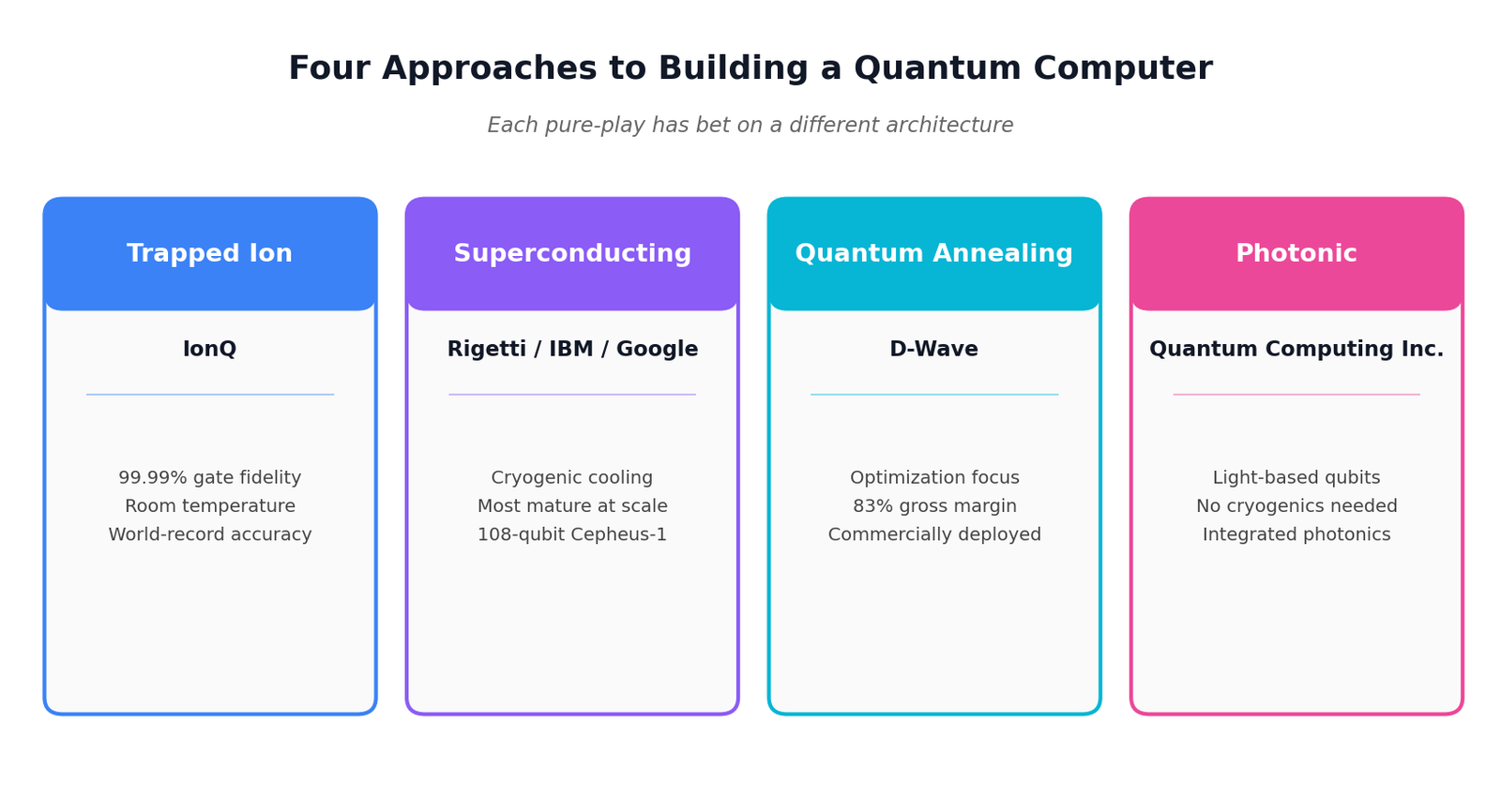
The four leading approaches — each company is betting on a different path to a working quantum computer.
Why the Mood Has Shifted
A few things are happening at once. Google’s Willow chip demonstrated “below-threshold” quantum error correction — meaning adding more qubits now reduces errors instead of multiplying them, a milestone the field has chased for two decades. IonQ crossed $100 million in annual revenue, becoming the first pure-play quantum company in history to do so. IBM is building a 511,000-square-foot facility in Poughkeepsie to manufacture its next-generation “Starling” fault-tolerant systems, targeted for 2029. Fortune Business Insights projects the quantum computing market will grow at roughly a 30% compound annual rate through 2034.
In plain English: the science is working, real revenue is showing up, and the build-out is starting.
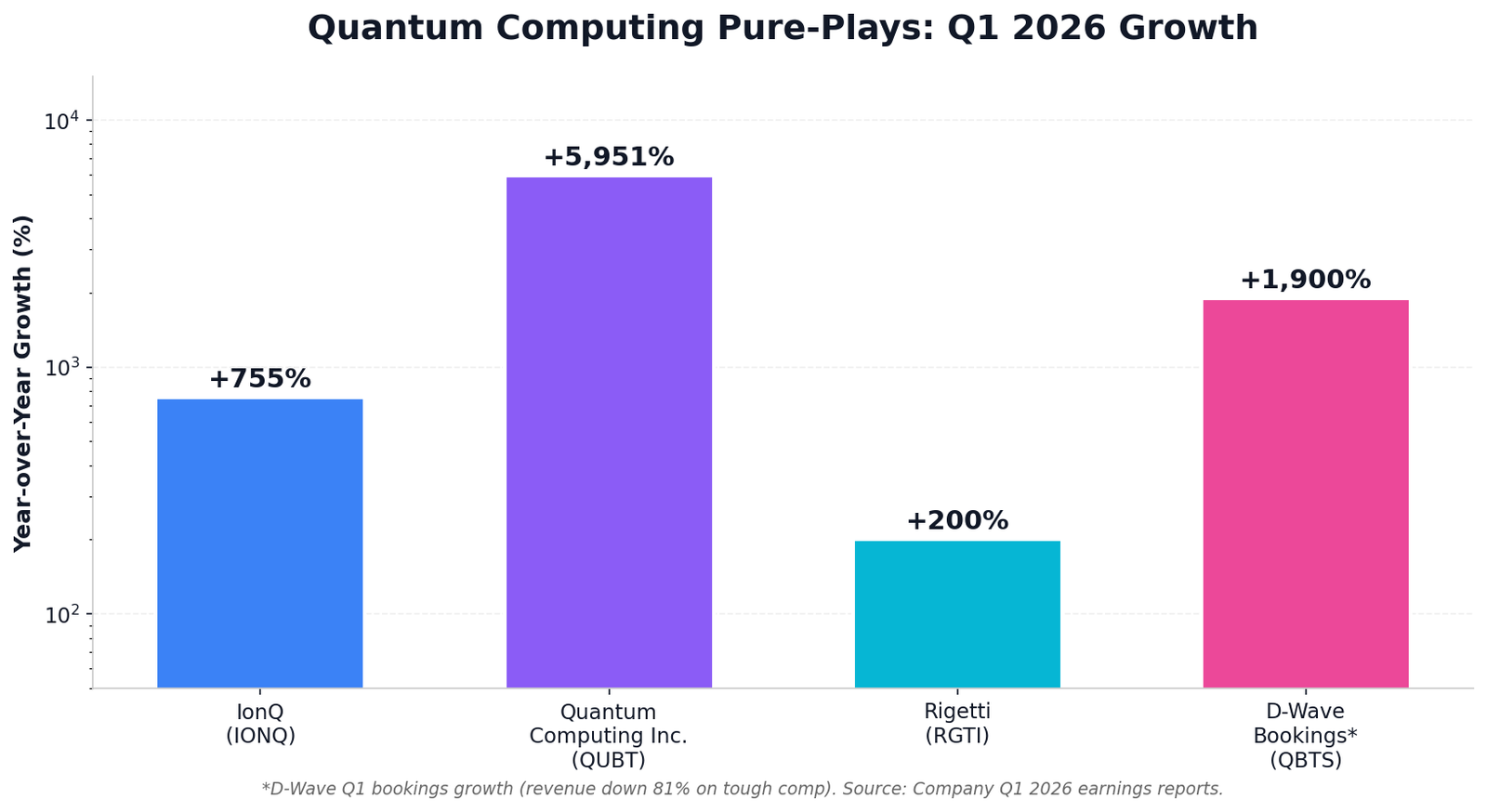
Q1 2026 year-over-year growth across the four pure-play quantum names (logarithmic scale).
The Stocks Worth Knowing
IonQ (NYSE: IONQ) is the current leader of the pure-plays. Its trapped-ion approach holds the world record for two-qubit gate fidelity at 99.99% — an enormous accuracy advantage over its rivals. Q1 2026 revenue came in at $64.7 million, up 755% year over year, and management raised full-year guidance to $260–270 million. The company is sitting on roughly $3.1 billion in cash and is acquiring SkyWater Technology to bring chip manufacturing in-house. It’s the closest thing the sector has to a “blue chip” pure-play, though it’s still unprofitable and trades at a rich valuation.
D-Wave Quantum (NYSE: QBTS) took a different path. Instead of building a general-purpose quantum computer, D-Wave bet on quantum annealing — a specialized technique tailored to optimization problems like logistics, scheduling, and routing. That niche is already paying real bills: 2025 revenue grew 179% year over year, with an 83% gross margin and a sales pipeline up nearly 1,500%. It recently landed a $20 million system sale to Florida Atlantic University and a $10 million deal with a Fortune 100 client. Higher risk than IonQ, but arguably the most commercially deployed quantum systems in the market.
Rigetti Computing (NASDAQ: RGTI) is the superconducting-qubit play. Smaller revenue base, but the company just launched its 108-qubit Cepheus-1 system, hit 99.9% two-qubit gate fidelity, and has roughly $590 million in cash to fund the next phase. It’s the highest-beta of the three pure-plays — meaning the biggest swings up and down — but analysts’ average price target implies meaningful upside if execution holds.
Quantum Computing Inc. (NASDAQ: QUBT) is the photonics-focused dark horse. Q1 2026 revenue jumped 5,951% year over year (off a tiny base) following its acquisition of Luminar Semiconductor. Highly speculative, but it’s now positioned in integrated photonics manufacturing — a strategically interesting corner of the sector.
IBM (NYSE: IBM) and Alphabet (NASDAQ: GOOGL) offer the lower-risk path in. Neither makes meaningful quantum revenue today, but both have research programs that rival or exceed anything the pure-plays have built. You’re effectively getting quantum exposure inside a profitable, dividend-paying or cash-generating tech business.
Defiance Quantum ETF (NYSE: QTUM) is the basket play. It holds dozens of companies across the quantum supply chain — pure-plays, hyperscalers, semiconductor partners — and removes the risk of picking the wrong architecture. For investors who want the theme without choosing a single winner, this is the cleanest option.
The Honest Risk Picture
This sector is not for grocery money. Pure-play quantum stocks routinely move 10–15% on no news. IonQ and D-Wave both posted 50%+ drawdowns in early 2026 before rallying back. Most of these companies are unprofitable and fund themselves through equity raises, which means existing shareholders get diluted. Architecture risk is real: if trapped-ion wins, superconducting players could lose their lead, and vice versa. And the most honest line in any analyst report on this sector is that commercial quantum advantage at scale is still likely a late-decade story.
The case for owning some quantum exposure isn’t that the payoff is here — it’s that by the time it’s obvious, the rerating will already have happened. Position sizing matters more than picking. Most disciplined investors cap speculative themes like quantum at a small percentage of their total portfolio, sized so a complete loss wouldn’t change their life.
The Bottom Line
Quantum computing has moved out of the “interesting science project” category and into “real industry with real revenue and real customers.” That doesn’t mean every stock in the space is a winner, and it doesn’t mean today’s prices are the bottom. But the sector has crossed the line from theoretical to investable, and the companies named above are the ones the market is currently rewarding for that shift.
For anyone who’s been waiting for quantum to matter before paying attention — it’s starting to matter.
This article is for informational purposes only and is not financial advice. Quantum computing stocks are highly speculative and volatile. Always do your own research and consider consulting a licensed financial advisor before investing.




Leave A Comment